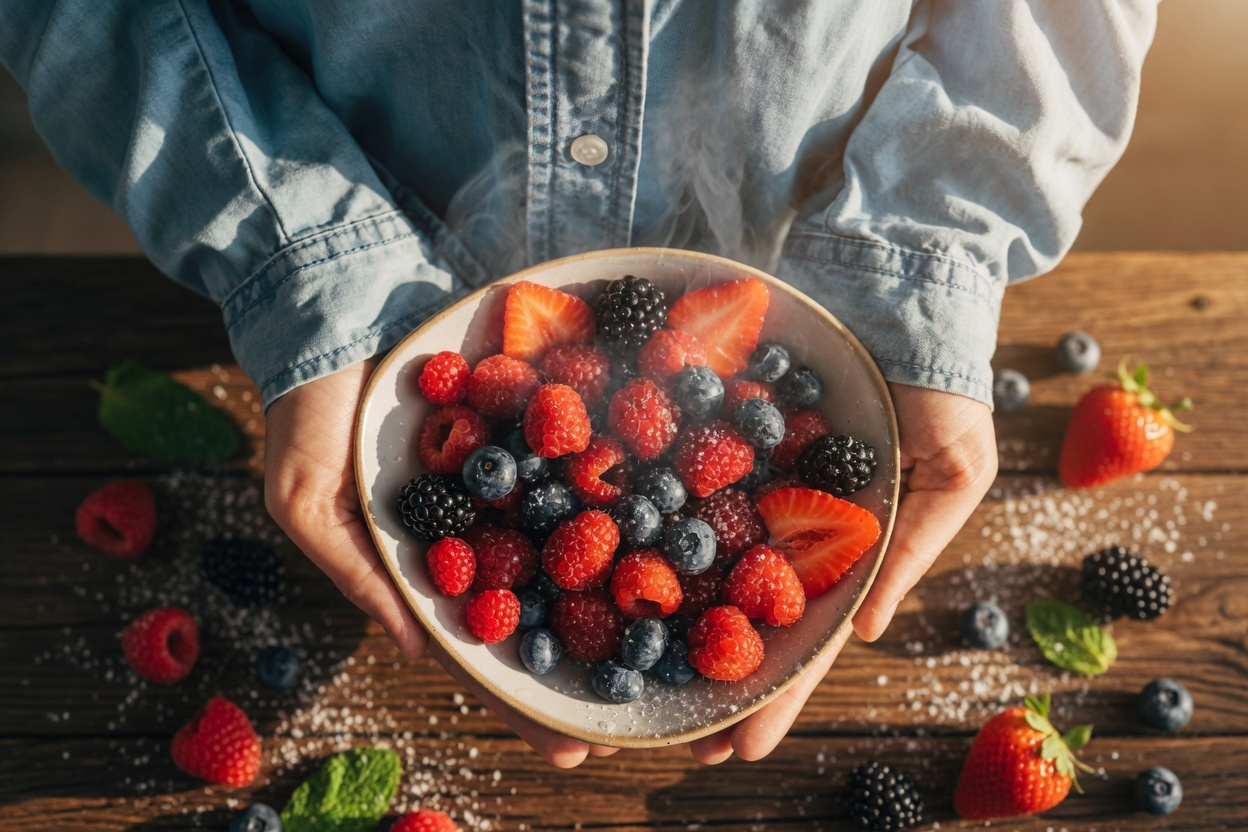
Knowing which fruits are the most nutritious, when to eat them, and how to combine them for maximum benefit is only half of the nutritional equation. The other half — and the half that most people struggle with far more — is actually building healthy fruit habits that stick consistently over months and years rather than weeks. Without sustainable healthy fruit habits, even the most sophisticated nutritional knowledge produces little real-world health benefit.
This complete guide explores 5 powerful strategies for building healthy fruit habits that genuinely last — from understanding the psychology of habit formation and reducing the friction that prevents daily fruit consumption, to building variety into your routine, shifting your mindset around fruit as a daily non-negotiable, and creating an environment that makes eating fruit the easiest and most natural choice throughout the day!
Most people genuinely want to eat more fruit — yet consistently fall short of even the modest recommendation of 2-3 servings daily. Understanding why healthy fruit habits are difficult to sustain is the first step toward building ones that actually work:
The Most Common Barriers to Consistent Fruit Consumption:
| Barrier | How It Manifests | Why It Derails Habits |
|---|---|---|
| Inconvenience | Fruit requires washing, cutting, or peeling | Processed snacks are faster and easier |
| Spoilage concern | Fresh fruit goes bad quickly | Fear of waste reduces buying frequency |
| Taste fatigue | Eating the same fruit daily becomes boring | Monotony kills motivation |
| Lack of visibility | Fruit stored in fridge drawer goes forgotten | Out of sight truly means out of mind |
| All-or-nothing thinking | Missing one day feels like failure | One missed day becomes a week |
| Competing priorities | Convenience foods are everywhere | Environment overrides intention |
The single most impactful strategy for building healthy fruit habits is not willpower or motivation — it is reducing the friction between the intention to eat fruit and the actual act of eating it.
Research in behavioral science consistently shows that small increases in friction — even just a few extra seconds or steps — dramatically reduce the likelihood of a behavior occurring. The reverse is equally true: reducing friction by just a few steps makes healthy behaviors significantly more likely to happen automatically.
Friction Reduction Strategies for Daily Fruit Consumption:
| Strategy | How to Implement | Friction Reduced | Time Investment |
|---|---|---|---|
| Pre-cut fruit in clear containers | Cut fruit on Sunday for the week | From 5 minutes to 0 minutes | 20 minutes per week |
| Fruit bowl on the counter | Keep 3-5 fruits visible at all times | Removes need to open fridge | 2 minutes setup |
| Frozen fruit for smoothies | Keep bags of frozen berries and mango | Always available — no ripeness concern | 5 minutes to stock |
| Pre-portioned snack bags | Portion fruit into grab-and-go bags | Ready in seconds | 10 minutes per week |
| Fruit at eye level in fridge | Store cut fruit at eye level not in drawer | Visual cue triggers consumption | 1 minute to reorganize |
The Counter Fruit Bowl Rule:
One of the most consistently effective healthy fruit habits across nutritional behavior research is the simple act of keeping a fruit bowl visible on the kitchen counter. Studies show that people who keep fruit visible on their counter eat significantly more fruit and have lower BMI than those who store fruit out of sight — regardless of their stated nutritional intentions.
What to Keep in Your Visible Fruit Bowl:
| Season | Counter Fruits | Why These Work |
|---|---|---|
| Any season | Bananas | Room temperature stable, no preparation needed |
| Any season | Apples | Last 1-2 weeks at room temperature |
| Any season | Oranges or mandarins | Durable, easy to peel, no cutting needed |
| Tropical season | Guava | Stays fresh several days at room temperature |
| Summer | Mangoes | Ripen beautifully at room temperature |
The most sustainable healthy fruit habits are built around a single weekly preparation session rather than daily preparation decisions:
Sunday Fruit Prep Routine (20-25 minutes total):
| Task | Time | Result | Lasts Until |
|---|---|---|---|
| Wash all berries | 3 minutes | Ready to eat immediately | Wednesday-Thursday |
| Cut watermelon into cubes | 5 minutes | Store in large container | Thursday-Friday |
| Slice mango and papaya | 5 minutes | Store in glass containers | Wednesday |
| Portion trail mix with dried fruit | 5 minutes | Individual snack bags | All week |
| Fill freezer bags with frozen fruit | 5 minutes | Always available for smoothies | Months |
One of the most common reasons healthy fruit habits collapse after a few weeks is taste fatigue — eating the same fruit every day until it becomes genuinely unappealing. Systematic variety rotation solves this problem while simultaneously maximizing nutritional coverage.
Rather than deciding what fruit to eat each day — a decision that adds friction and often defaults to the same familiar options — a pre-planned two-week rotation eliminates decision fatigue while ensuring nutritional variety:
Week 1 Rotation:
| Day | Morning Fruit | Afternoon Fruit | Evening Fruit | Key Nutrients Covered |
|---|---|---|---|---|
| Monday | Papaya | Blueberries | Kiwi | Enzymes + anthocyanins + serotonin |
| Tuesday | Guava | Apple + almond butter | Tart cherry | Vitamin C + pectin + melatonin |
| Wednesday | Watermelon | Berries + yogurt | Banana | Lycopene + probiotics + magnesium |
| Thursday | Kiwi | Mango | Tart cherry juice | Vitamin C + beta-carotene + sleep |
| Friday | Papaya | Pear + nuts | Kiwi | Enzymes + fiber + serotonin |
| Saturday | Guava | Pineapple | Banana | Vitamin C + bromelain + B6 |
| Sunday | Mango | Pomegranate seeds | Tart cherry | Beta-carotene + punicalagins + melatonin |
Week 2 Rotation:
| Day | Morning Fruit | Afternoon Fruit | Evening Fruit | Key Nutrients Covered |
|---|---|---|---|---|
| Monday | Kiwi | Strawberries | Banana | Vitamin C + ellagic acid + magnesium |
| Tuesday | Papaya | Blueberries + yogurt | Kiwi | Papain + anthocyanins + serotonin |
| Wednesday | Watermelon | Apple | Tart cherry | Citrulline + pectin + melatonin |
| Thursday | Guava | Pear | Passion fruit | Vitamin C + fiber + alkaloids |
| Friday | Mango | Mixed berries | Kiwi | Vitamin A + antioxidants + serotonin |
| Saturday | Papaya | Citrus segments | Banana | Enzymes + hesperidin + tryptophan |
| Sunday | Kiwi + guava | Pomegranate | Tart cherry juice | Full vitamin C + punicalagins + melatonin |
For those who find a detailed rotation system overwhelming, the simpler color rotation framework ensures variety without requiring a specific plan:
| Day | Color Target | Example Fruits | Key Phytonutrient |
|---|---|---|---|
| Monday | Deep purple-blue | Blueberries, grapes, blackberries | Anthocyanins |
| Tuesday | Bright red | Strawberries, watermelon, pomegranate | Lycopene, ellagic acid |
| Wednesday | Orange-yellow | Mango, papaya, citrus, apricot | Beta-carotene, vitamin C |
| Thursday | Green | Kiwi, avocado, honeydew, lime | Vitamin K, folate, lutein |
| Friday | Mixed tropical | Guava, pineapple, dragon fruit | Broad tropical phytonutrients |
| Saturday | White-cream | Banana, pear, lychee | Quercetin, potassium |
| Sunday | Free choice | Whatever appeals most | Enjoyment sustains the habit |
The third strategy for building healthy fruit habits is habit stacking — attaching fruit consumption to existing daily routines that already happen automatically, so that the new habit piggybacks on established behavioral patterns.
| Existing Habit | Stacked Fruit Habit | Practical Implementation |
|---|---|---|
| Morning coffee or tea | Eat fruit while waiting for coffee to brew | Banana or pre-cut fruit beside the kettle |
| Breakfast preparation | Add fruit to breakfast automatically | Berries on oatmeal, sliced fruit alongside eggs |
| Midday work break | Eat afternoon fruit during break | Pre-portioned fruit at desk or in work bag |
| Post-lunch walk | Eat fruit before or during the walk | Mandarin or apple — easy to eat while walking |
| Gym session | Pre-workout banana + post-workout smoothie | Banana in gym bag, frozen fruit at home |
| Evening TV time | Replace processed snack with fruit | Fruit bowl next to the couch replaces chip bowl |
| Before bed routine | Two kiwis one hour before sleep | Kiwis on bedside table ready the night before |
Research by psychologist Peter Gollwitzer shows that forming specific “if-then” plans — called implementation intentions — dramatically increases the likelihood of following through on intended behaviors. Applied to healthy fruit habits:
Example Implementation Intentions:
| Trigger (If) | Action (Then) | Specificity |
|---|---|---|
| If I make my morning coffee | Then I eat one piece of fruit while it brews | Time + location + action |
| If it is my midday break | Then I eat my pre-portioned fruit from my bag | Time + location + action |
| If I finish my workout | Then I drink my recovery smoothie within 30 minutes | Event + action + timing |
| If I sit down to watch TV | Then I bring my fruit bowl to the couch | Event + location + action |
| If it is one hour before bed | Then I eat my two kiwis | Time + specific fruit + amount |
The fourth strategy for building lasting healthy fruit habits is one of the most counterintuitive — starting with a target so small that it feels almost embarrassingly easy, and building from there.
Most people begin fruit consumption goals with ambitious targets — five servings daily, a smoothie every morning, fruit with every meal. These targets feel motivating at the start but collapse when life gets busy, when fruit runs out, or when motivation inevitably fluctuates.
The minimum viable habit approach sets the initial target at a level so achievable that there is virtually no barrier to success:
The Minimum Viable Fruit Habit Progression:
| Phase | Duration | Daily Target | Success Criteria |
|---|---|---|---|
| Phase 1 — Foundation | Weeks 1-2 | One piece of fruit per day | Achieved at least 6 of 7 days |
| Phase 2 — Building | Weeks 3-4 | Two pieces of fruit per day | Achieved at least 6 of 7 days |
| Phase 3 — Expanding | Weeks 5-8 | Two pieces + one smoothie on workout days | Achieved at least 5 of 7 days |
| Phase 4 — Establishing | Weeks 9-12 | Three servings daily with variety | Achieved at least 5 of 7 days |
| Phase 5 — Sustaining | Week 13+ | Three servings daily as non-negotiable | Built into daily routine automatically |
The Never Miss Twice Rule:
One of the most important mindset shifts for maintaining healthy fruit habits long-term is abandoning the all-or-nothing thinking that causes most habit attempts to collapse permanently after a single missed day:
| Mindset | Response to Missing One Day | Long-Term Outcome |
|---|---|---|
| All-or-nothing | Give up — feel like a failure | Habit collapses permanently |
| Never miss twice | Get back on track the very next day | Habit survives and strengthens |
Missing one day of fruit consumption has essentially zero health impact. Missing weeks and months because a single missed day triggered abandonment has significant health impact. The never-miss-twice rule treats a single missed day as a data point — not a verdict.
The fifth and most powerful long-term strategy for healthy fruit habits is environmental design — deliberately arranging your physical environment so that fruit consumption becomes the automatic default rather than a deliberate choice.
Principle 1 — Make Fruit the Most Visible Food in Your Home:
| Location | What to Place There | Effect |
|---|---|---|
| Kitchen counter | Fruit bowl with 3-5 varieties | First food seen when entering kitchen |
| Fridge eye level | Pre-cut fruit in clear containers | First food seen when opening fridge |
| Office desk | Fruit or dried fruit portion | Available without leaving the desk |
| Car | Non-perishable fruit — apples, mandarins | Available during commute or errands |
| Gym bag | Banana or energy dates | Available immediately pre or post-workout |
Principle 2 — Make Processed Snacks Less Accessible:
Environmental design works in both directions — increasing fruit accessibility while simultaneously reducing the convenience of competing processed snacks:
| Action | Effect on Behavior |
|---|---|
| Store processed snacks in high cupboards | Out of immediate reach reduces impulse consumption |
| Remove processed snacks from visible counter space | Reduces visual triggers for processed snack consumption |
| Keep fruit at eye level, processed snacks below | Visual hierarchy reinforces fruit as default choice |
| Shop for fruit first at grocery store | Full cart prioritizes fresh produce over processed items |
Principle 3 — The Shopping List System:
Consistent healthy fruit habits require consistent fruit availability — which requires a systematic approach to grocery shopping:
Weekly Fruit Shopping Template:
| Category | Weekly Amount | Purpose |
|---|---|---|
| Countertop fruits (bananas, apples, citrus) | 6-8 pieces | Daily grab-and-go |
| Pre-cut or easy fruits (berries, grapes, kiwi) | 2-3 cups | Snacking and breakfast |
| Tropical fruits (mango, papaya, guava) | 2-3 pieces | Nutritional variety |
| Frozen fruits (berries, mango, mixed) | 2 bags | Smoothies — always available |
| Sleep-support fruits (kiwi, tart cherry) | 6-7 kiwis + 1 bottle tart cherry juice | Evening routine |
Principle 4 — Social Environment and Accountability:
The social environment powerfully shapes eating habits — people consistently eat more similarly to those around them than they realize:
| Social Strategy | How to Implement | Effect on Habits |
|---|---|---|
| Share fruit habit goals with household members | Communicate the why and the plan | Creates mutual accountability |
| Keep shared fruit available for all household members | Make it a household norm | Normalizes fruit consumption for everyone |
| Track progress visibly | Simple calendar on fridge — mark each day | Visual progress reinforces the habit |
| Find an accountability partner | Check in weekly on fruit consumption | Social commitment increases follow-through |
For a complete guide on the best fruits for health benefits, visit our main resource on Best Fruits for Health Benefits: 7 Complete Guides!
Reducing friction is the single most effective strategy — making fruit the easiest food to access in your environment consistently outperforms willpower and motivation. Keeping a visible fruit bowl on the counter, pre-cutting fruit on weekends, and storing cut fruit at eye level in the fridge are the three highest-impact environmental changes for building lasting healthy fruit habits.
Research on habit formation suggests that simple habits take an average of 66 days to become automatic — not the commonly cited 21 days. For healthy fruit habits specifically, the minimum viable habit approach — starting with just one piece of fruit daily and building gradually over 12 weeks — produces significantly higher long-term success rates than ambitious targets that collapse under the pressure of daily life.
Apply the never-miss-twice rule — treat a single missed day as completely irrelevant to your long-term healthy fruit habits and simply resume the very next day without self-criticism. Missing one day of fruit consumption has zero measurable health impact. The all-or-nothing thinking that treats one missed day as a reason to abandon the habit entirely is the primary reason most healthy eating intentions fail.
Variety is significantly more valuable than large quantities of a single fruit. Different fruits provide different antioxidants, phytonutrients, fiber types, and vitamins — no single fruit provides everything the body needs. Eating 2-3 different fruits daily across a weekly rotation that covers different color groups ensures the broadest possible spectrum of nutritional benefits from your healthy fruit habits.
The batch preparation method is the most practical solution for busy schedules — spending 20-25 minutes on Sunday preparing and portioning fruit for the entire week eliminates the daily time barrier completely. Additionally, keeping ready-to-eat fruits like bananas, apples, and mandarins visible and accessible requires no preparation at all and can be consumed in 2-3 minutes anywhere throughout the day.